
End of Life for Windows 10: Risk and Strategies for Users in Low- and Middle-Income Economies
- 10/04/2025
- Posted by: admin
- Categories: Cybersecurity, Digital Inclusion and Access, Governance and Regulation, ICT for Development (ICT4D), Information Technology, Market Analysis, Technology Policy
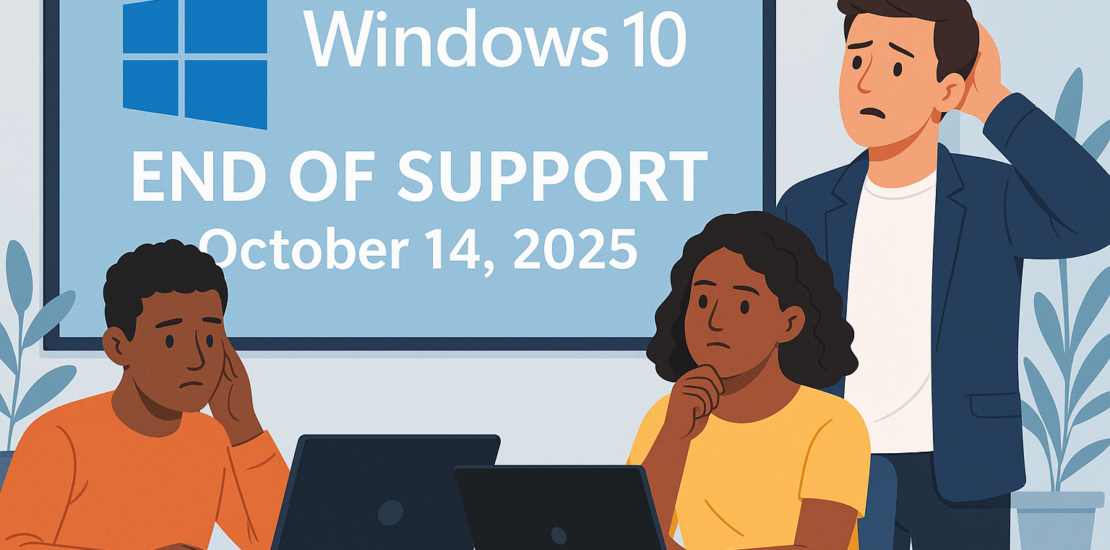
On October 14, 2025, Microsoft will officially end support for Windows 10, marking a pivotal moment for millions of users globally, especially in low- and middle-income countries (LMICs). After this date, the operating system will no longer receive free security updates, patches, or technical support. While this transition may seem routine in high-income countries, it carries far-reaching implications for LMICs, where Windows 10 is still deeply entrenched in the digital infrastructure of public institutions, businesses, and everyday users.
With 63.1% of users in Africa, 62.89% in Kenya, and 62.13% in India still relying on Windows 10 as of March 2025, compared to the global average of 54.23%, the stakes are undeniably high. The transition presents not only cybersecurity risks but also challenges related to affordability, sustainability, and access to digital services. However, this shift should not be viewed solely as a crisis, it also offers an opportunity to rethink strategies for inclusive, resilient, and secure digital development.
The Cybersecurity Risk
One of the most pressing concerns surrounding the end of support is the increased exposure to cybersecurity threats. Without regular updates, Windows 10 systems will be more vulnerable to malware, ransomware, and targeted attacks. This risk is especially acute for public institutions, small and medium-sized enterprises (SMEs), and essential service providers, who rely on these systems for daily operations and the handling of sensitive data.
While continuing to use Windows 10 beyond October 2025 is not inherently reckless, especially for individuals or smaller organisations operating with limited resources. Users can still take important steps to protect their systems and reduce exposure to threats. These include:
-
- Installing reputable third-party antivirus and security system software
- Practising good cyber hygiene, such as using strong passwords, disabling unnecessary services, and conducting regular backups
- Avoiding high-risk browsing behaviours and suspicious downloads
- Keeping browsers and critical applications updated
Even though these measures cannot replace the foundational protection provided by operating system-level security updates, they can serve as meaningful safeguards, especially for users who are unable to upgrade immediately.
Extended Security Updates (ESUs) as a Temporary Solution
For organisations that may require continued protection, Microsoft is offering an Extended Security Updates (ESUs) programme. The programme provides critical security updates beyond the end-of-support date from October 2025 to October 2026, with the possibility of annual renewal for up to three years.
The cost of licensing for ESU varies. For individuals and Windows 10 Home users, the ESU will cost $30 per device for one year. For enterprises and educational institutions, ESUs can be purchased through Microsoft’s Volume Licensing programme at $61 per device for the first year, with the cost doubling each year thereafter.
While this may be a manageable expense in high-income settings, the cost becomes significant when applied across multiple computers in underserved and low- and middle-income countries, particularly in government departments, schools, or clinics already facing resource constraints.
To be eligible for ESUs, devices must be running Windows 10, version 22H2. The programme covers security updates only and does not include new features, customer-requested non-security patches, or broader technical support. However, devices running Windows 10 Long-Term Servicing Channel (LTSC) editions will have a longer official support window, offering some flexibility for organisations already using these versions.
Microsoft has confirmed that Windows 10 devices will continue to function beyond the end-of-support date, even without ESUs. However, systems that do not receive regular updates will become increasingly vulnerable to security threats. For cloud-connected devices, Windows 365 and Azure Virtual Desktop users will receive ESUs at no additional cost, as long as they hold an active subscription.
It’s also important to note that ESUs must be purchased in full-year increments and are cumulative, meaning if a user decides to enrol in Year Two, they must also pay for Year One. This makes the ESU programme a temporary stopgap, not a long-term substitute for upgrading.
Its limited duration underscores the importance of proactive transition planning. Organisations relying on the ESU programme should begin preparing now for what comes next—whether that means migrating to Windows 11, exploring alternative systems, or investing in infrastructure upgrades.
Hardware Limitations and the Cost of Upgrading
Another major hurdle for LMICs is that Windows 11 requires more advanced hardware, such as Trusted Platform Module (TPM) 2.0 support, which is found in computers manufactured from 2018, and newer-generation CPUs. Many existing computers in these regions do not meet these technical requirements, rendering them incompatible with Microsoft’s latest OS.
This creates a stark affordability challenge. Replacing otherwise functional devices simply to meet system requirements may be financially out of reach for many public institutions, NGOs, and small businesses. Even when upgrades are possible, they can be slow and unevenly distributed, particularly where public funding is limited or procurement processes are complex.
Adding to this is the ongoing prevalence of unlicensed or pirated Windows installations across many of these countries. Driven by high licensing costs and limited enforcement, unofficial software use remains widespread. These systems already present significant cybersecurity and reliability risks, and once Windows 10 support ends, they will become even more vulnerable, posing risks not only to individual users but also to broader digital ecosystems, particularly in sectors that handle sensitive data.
The Environmental Impact: A Looming E-Waste Crisis
Beyond digital security, the end of Windows 10 raises another critical concern of electronic waste (e-waste). The move to Windows 11 could trigger widespread disposal of older, yet still functional, computers that do not meet new hardware requirements.
This creates a significant environmental challenge, especially in LMICs, where old electronic devices from the Global North often end up, and where formal e-waste recycling systems are limited or non-existent. In many parts of the Global South, informal e-waste processing is conducted under hazardous conditions, exposing workers, who are often children, to toxic substances while polluting local environments.
If the environmental impact is not addressed, this wave of discarded devices could exacerbate an already growing environmental and public health crisis. This challenge underscores the urgent need for stronger e-waste regulations, enhanced partnership agreements between manufacturers and government, efforts to address the electronic manufacturing gap in Africa, improved infrastructure for safe recycling, and better coordination between digital transition strategies and environmental sustainability.
Exploring Alternatives and Strategic Options
Given these intersecting challenges, LMICs should consider implementing adaptable, forward-looking strategies. Several viable options and complementary approaches are worth exploring, including:
- Adopting open-source operating systems like Linux, which can offer cost-effective, secure alternatives that work well on older devices. While implementation requires user education and institutional support, these systems could offer a long-term solution for resource-constrained settings.
- Subsidising upgrades through blended financing can help ensure that public institutions and essential service providers are not left behind. Governments, development partners, and private sector players can work together to co-finance hardware replacement and digital infrastructure expansion.
- Promoting digital literacy and cybersecurity education at all levels is essential. Even when immediate upgrades are not feasible, users should have the knowledge and tools to protect themselves and their organisations.
- Investing in circular economy and e-waste management systems will help mitigate the environmental costs of digital transitions. This includes formalising e-waste recycling channels and regulating the import of near-end-of-life devices.
Could Regional Support Be a Viable Strategy?
As the world prepares for the end of Windows 10 support, one question worth exploring is whether Microsoft could adopt region-specific strategies to address the disproportionate impact on users in LMICs. With usage rates still above 60% in Africa, Kenya, and India, a uniform global phaseout presents a substantial risk of exacerbating digital inequality and undermining efforts to digitise essential services.
Offering extended or tiered support specifically for these countries could allow Microsoft to acknowledge the economic and infrastructural realities faced by governments, schools, and small enterprises. Such strategies might include discounted Extended Security Update (ESU) programmes, targeted extensions for public sector institutions, or partnerships with development agencies to co-design localised transition pathways.
From a development and sustainability perspective, regional consideration would also help slow the growth of e-waste. Many currently used devices are still functional but do not meet Windows 11’s system requirements. Continued secure use of Windows 10, even for a limited time, could reduce premature disposal of these machines, especially in countries where formal e-waste recycling infrastructure is lacking.
While operational complexity, software piracy, and Microsoft’s broader shift toward Windows 11 and cloud services may pose limitations, there is room for creative policy and partnership-based solutions. Some viable approaches Microsoft could consider include:
- Tiered or subsidised ESU pricing
Microsoft could offer reduced-cost security updates in countries with a high reliance on Windows 10 and limited capacity to transition, ensuring users remain protected while planning for longer-term upgrades. - Public sector-specific support extensions
Support could be selectively extended to essential public sector services such as education, healthcare, and digital government infrastructure, where transition budgets and procurement timelines are typically slower. - Public-private partnerships with development actors
Collaborations with donor agencies, multilaterals, and regional bodies could enable co-funded security support or upgrade programmes for high-impact use cases.
- Tailored cloud-first offerings
Instead of prolonging Windows 10 support indefinitely, Microsoft could introduce lightweight, cloud-based alternatives, like Windows 365 or Azure Virtual Desktop, optimised for low-resource settings. - Support tied to compliance and licensing reform
In regions where software piracy is a challenge, Microsoft could consider bundling support with regularisation programmes that promote legal use while offering phased incentives and training.
Ultimately, while a regional support model is not without its challenges, it aligns with the growing global emphasis on inclusive, sustainable digital transformation. As LMICs continue to integrate digital tools into public service delivery and economic participation, a collaborative and flexible approach to technology transitions will be key.
Governments, civil society, and regional blocs have a role to play in opening dialogue with Microsoft and similar technology providers. By advocating for transitional support and local capacity-building, stakeholders can help shape a digital future that doesn’t leave millions behind.
Conclusion: Planning for a Gradual, Inclusive Transition
The end of Windows 10 support represents a significant turning point, but it is also an opportunity to rethink how we approach digital transformation, particularly in LMICs. While the risks are real, the transition doesn’t need to be abrupt or exclusionary. With careful planning, targeted investment, and inclusive policy frameworks, countries can move forward in ways that are secure, sustainable, and equitable.
A phased approach—grounded in affordability, awareness, and resilience—will allow institutions and individuals to navigate this shift without deepening the digital divide. As October 2025 approaches, collaboration between governments, the private sector, and international partners will be critical to supporting communities that are most at risk of being left behind.